OTT Advertising Agency Guide for Local Service Businesses: Real Examples, Costs, and What Actually Works
If you run a home service business, working with an OTT advertising agency can put your brand in front of local homeowners while they watch streaming TV, YouTube, and other video content. Think of it as a more targeted version of traditional TV advertising—without paying to show your ad to half the state.
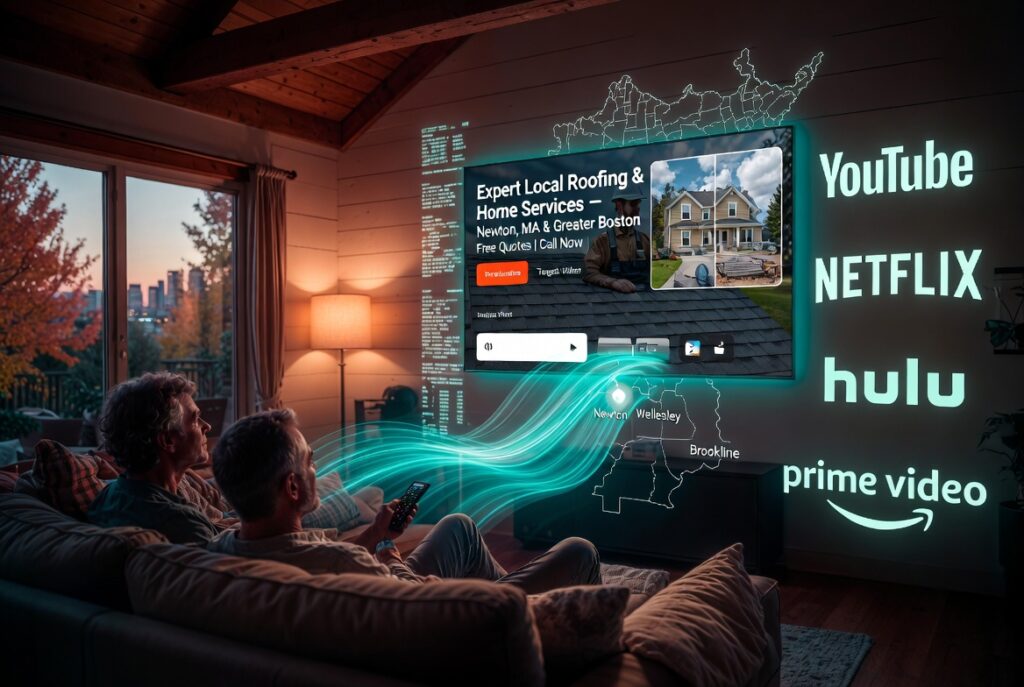
For roofing companies, garage door contractors, fence installers, locksmiths, handymen, and other local trades, OTT can work well when you want more brand awareness, better zip-code targeting, and another way to stay in front of people before they need your service.
The key is using it the right way. Below are real OTT ad examples, a simple breakdown of how OTT works, and practical tips for running campaigns that actually help generate leads.
5 OTT advertising examples worth copying
Big brands use OTT in smart ways, but the ideas behind their ads can work for local businesses too. You do not need a national budget to apply the same strategy.
1. T. Rowe Price: simple lead capture
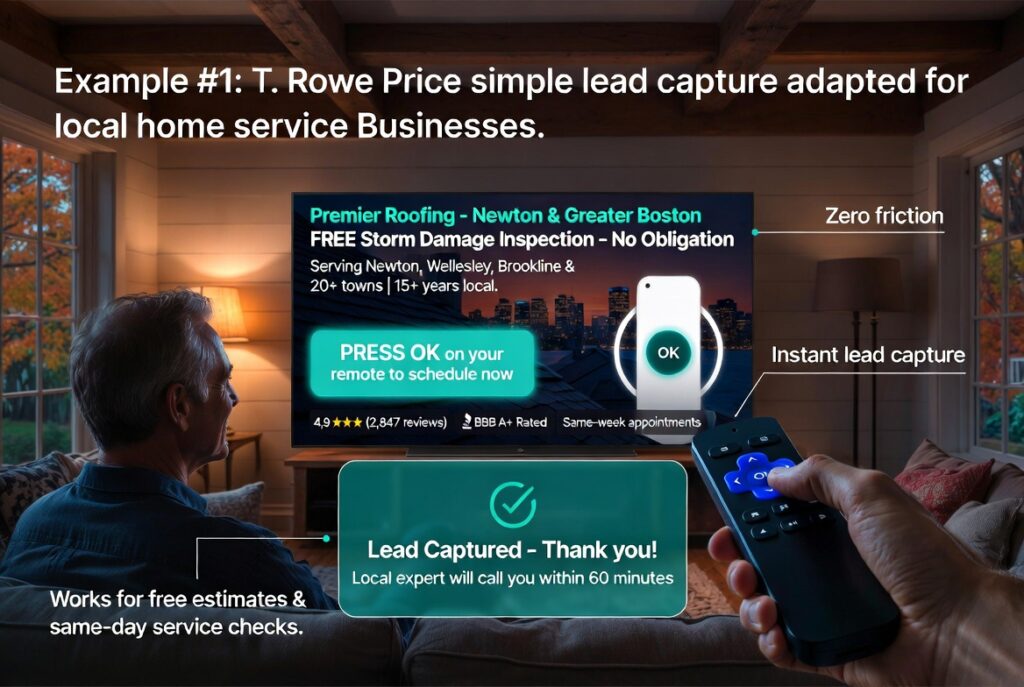
T. Rowe Price ran an OTT ad that let viewers request more information by pressing the “OK” button on their Roku remote.
Why it worked:
– It reduced friction
– It gave the viewer an easy next step
– It captured interest without asking people to leave the screen
What local businesses can learn:
If you offer financing, free estimates, seasonal inspections, or a homeowner guide, make the response easy. The fewer steps people take, the better your conversion rate usually gets.
For example, a roofing company could run an ad offering a free storm damage inspection. A garage door company could promote a same-day service check.
2. Ring: shoppable ad experience
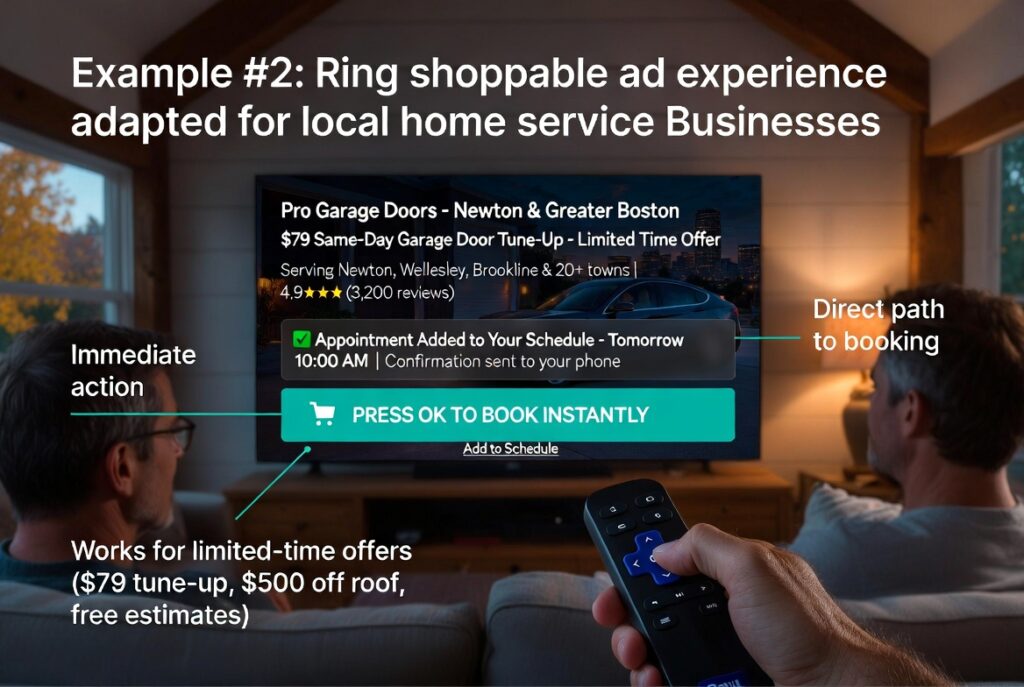
Ring used OTT to let viewers add a product directly to their Amazon cart from the ad itself.
Why it worked:
– It created immediate action
– It matched the ad to buyer intent
– It made the purchase process fast
What local businesses can learn:
Most contractors are not selling products through a shopping cart, but the same principle applies: give people a direct path to book, call, or request a quote.
If you are running a limited-time offer like:
– $79 garage door tune-up
– Free fence estimate
– $500 off full roof replacement
– Same-day locksmith service
Your ad should make the next step obvious and immediate.
3. Volvo: audience choice and segmentation
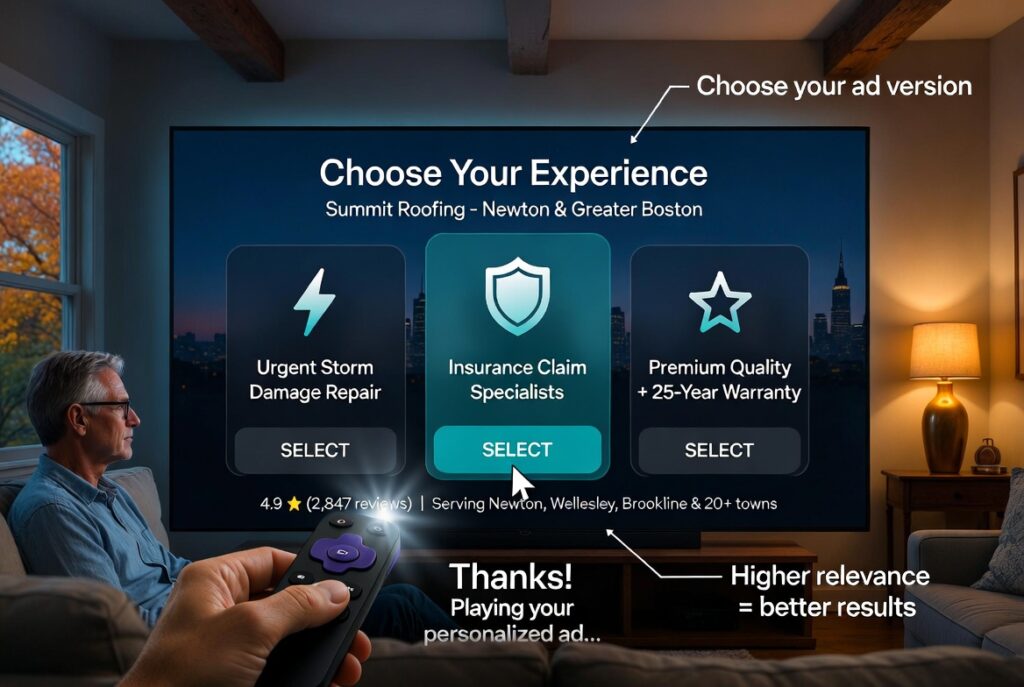
Volvo created multiple ad versions for different audience types and let viewers choose which version they wanted to watch.
Why it worked:
– It made the ad more relevant
– It improved engagement
– It gave Volvo useful first-party audience data
What local businesses can learn:
Different customers care about different things. A handyman customer may care about speed. A roofing customer may care about insurance claims. A fence buyer may care about privacy, security, or curb appeal.
Instead of running one generic ad, create separate versions for:
– Price-focused homeowners
– Urgent repair customers
– Quality-focused buyers
– Customers looking for financing
The more relevant the message, the better the response.
4. Maybelline: brand lift through value
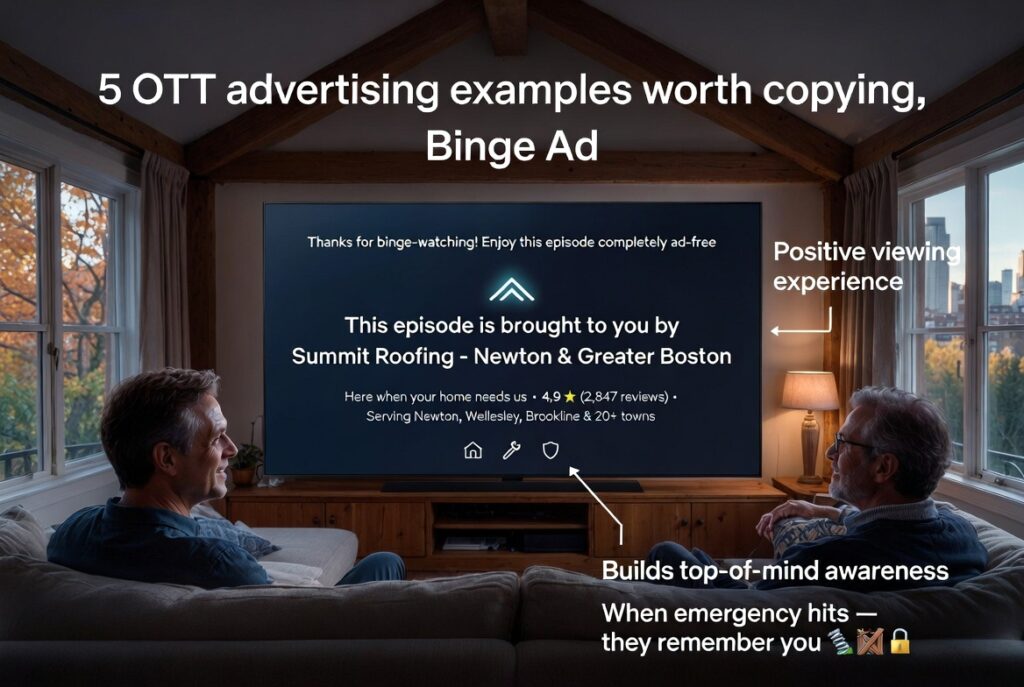
Maybelline used a “binge ad” format, where the brand sponsored an ad-free episode after someone watched multiple episodes in a row.
Why it worked:
– It gave viewers something positive
– It built brand awareness without hard selling
– It attached the brand to a better viewing experience
What local businesses can learn:
Not every ad needs to push for an immediate lead. Sometimes the goal is to make sure homeowners in your service area know your name before they need help.
That matters in local service businesses because a lot of buying decisions happen fast. When a spring breaks, a fence falls, or a lock fails, people usually call a company they have seen before.
5. NewYork-Presbyterian Hospital: short, emotional story
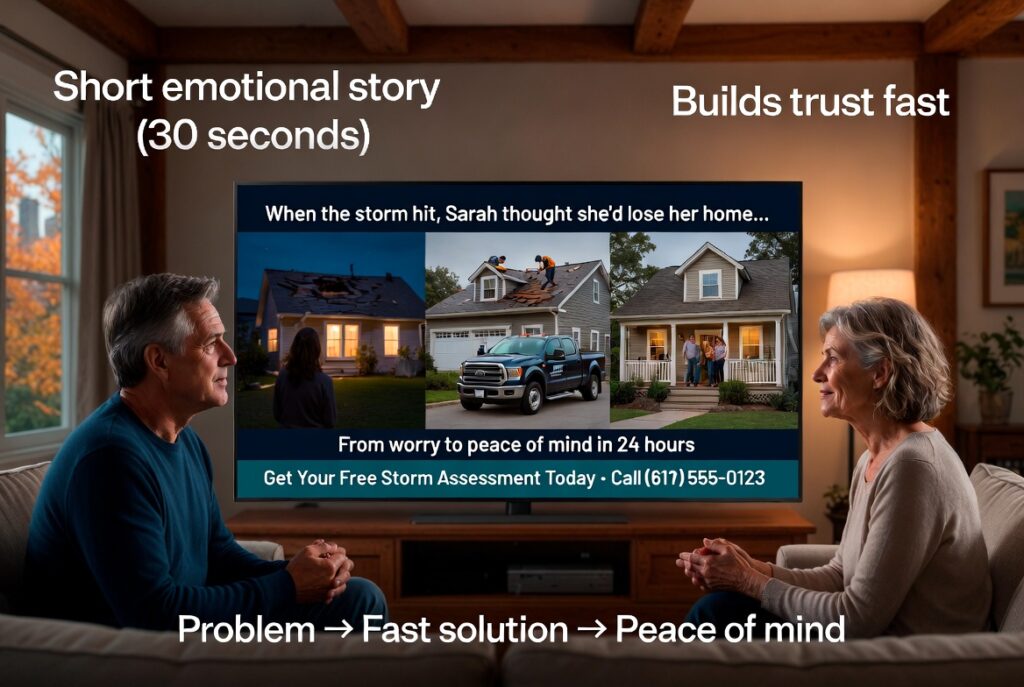
The hospital used a short in-stream video ad to tell a patient recovery story.
Why it worked:
– It used emotion without being overdone
– It built trust quickly
– It told a clear story in about 30 seconds
What local businesses can learn:
Storytelling works. A before-and-after, a customer problem, or a quick real-world example can make your ad more memorable.
A simple local contractor ad could follow this format:
1. Homeowner has a problem
2. Your team shows up fast
3. You fix it professionally
4. The customer gets peace of mind
5. Strong call to action
That is often more effective than a generic “We are the best in town” message.
What an OTT advertising agency actually helps with
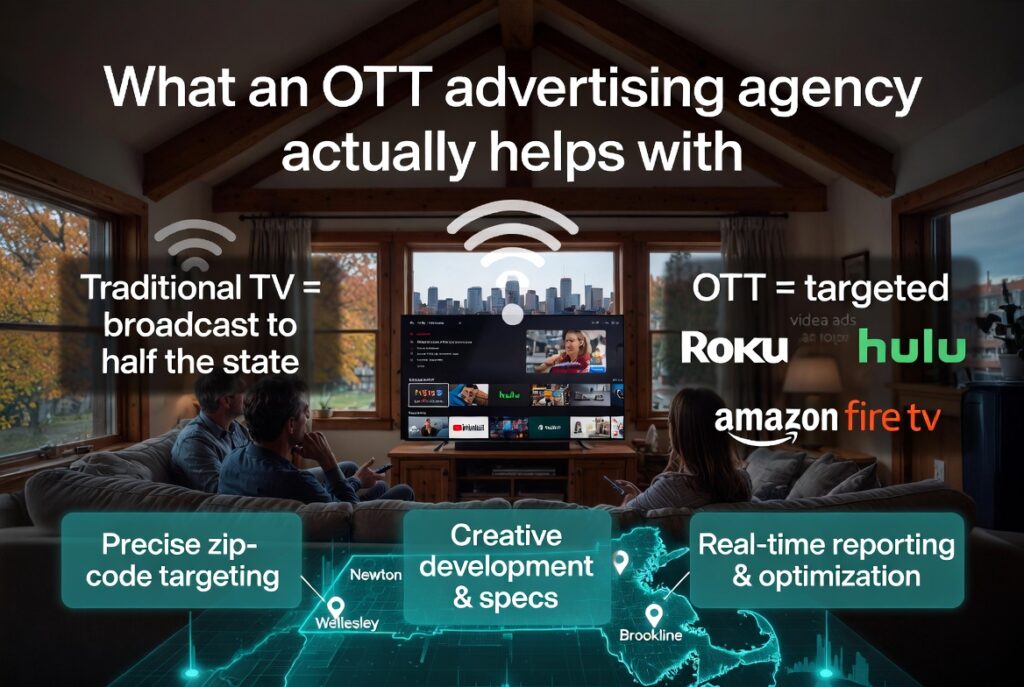
OTT stands for “over-the-top.” It means video content delivered over the internet instead of through traditional cable or satellite TV.
In plain English: if someone is watching content on Roku, Hulu, YouTube, Amazon Fire TV, or another streaming platform, that is OTT.
OTT advertising means your ad appears while people watch that streamed content.
For many local businesses, an OTT advertising agency helps manage the technical side of targeting, placement, creative specs, reporting, and campaign optimization.
OTT vs. CTV: what is the difference?
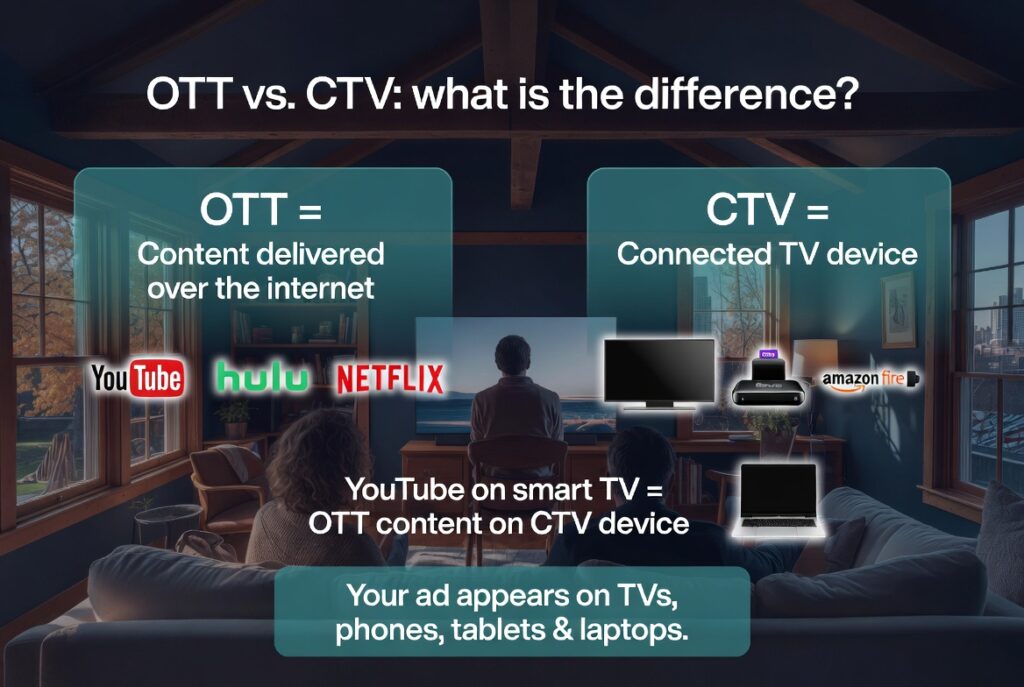
These terms get mixed up a lot.
– OTT = the content delivered over the internet
– CTV = the connected TV device used to watch it
So if someone watches YouTube on a smart TV, the TV is the CTV device and the content is OTT.
For most business owners, the important point is simple: your ad can appear on streaming platforms people watch at home on their TVs, phones, tablets, and laptops.
What devices and platforms count as OTT?
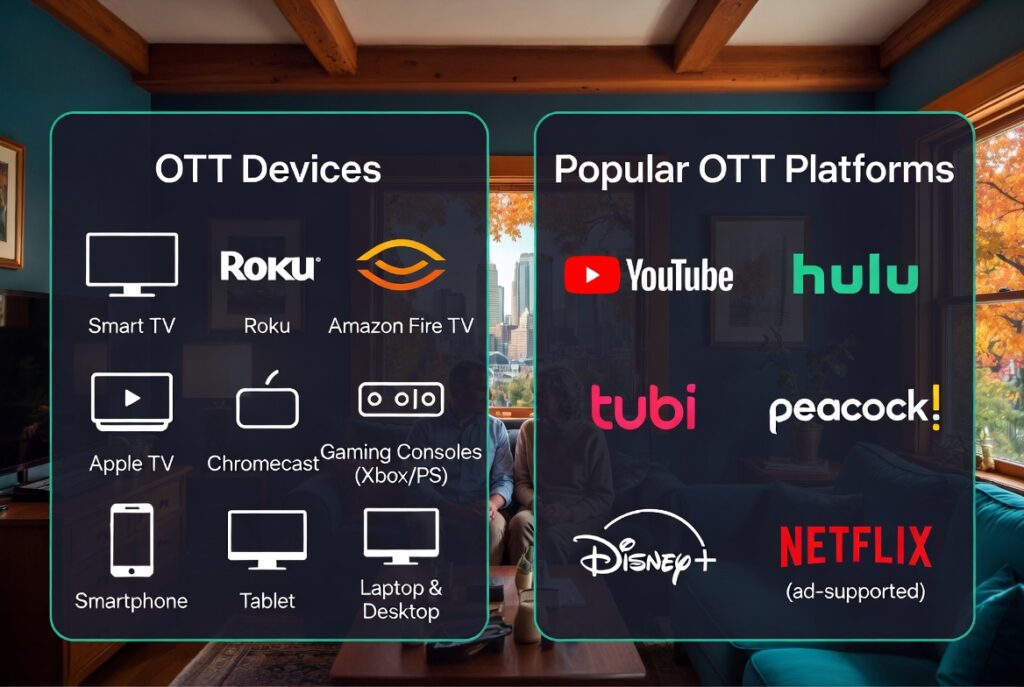
OTT can show up on:
– Smart TVs
– Roku devices
– Amazon Fire TV
– Apple TV
– Chromecast
– Gaming consoles
– Smartphones
– Tablets
– Laptops and desktop computers
Common OTT platforms include:
– YouTube
– Hulu
– Tubi
– Peacock
– Disney+
– Amazon Prime Video
– Netflix ad-supported plans
– YouTube TV and similar streaming services
Why OTT advertising can work for local businesses
For home service companies, OTT is not a replacement for Google Ads or Local Services Ads. It is usually a support channel.
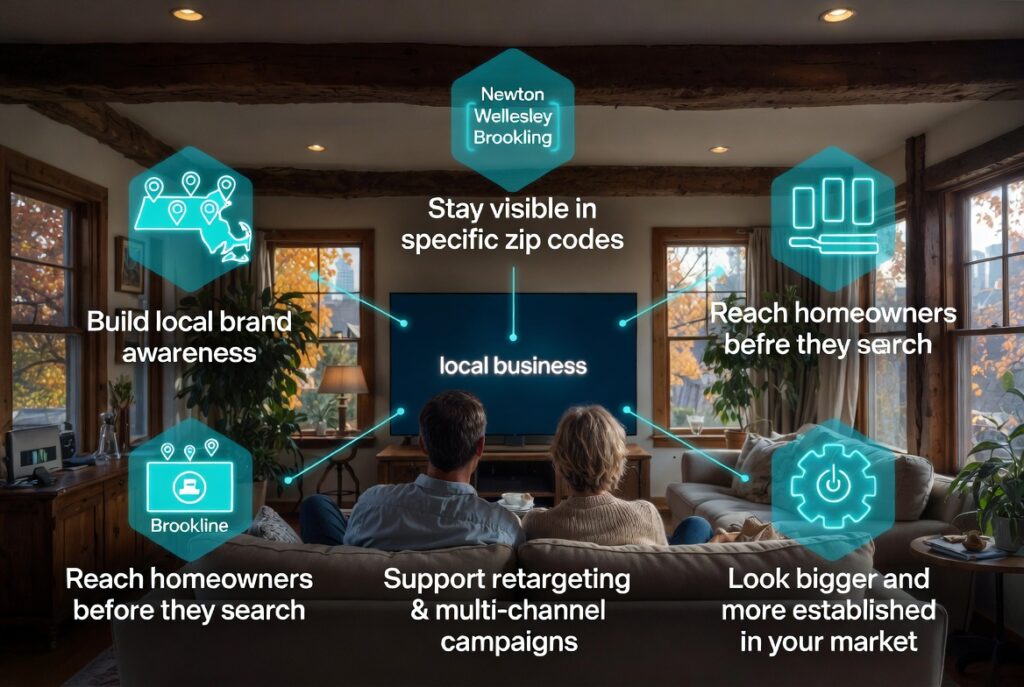
It works best when you want to:
– Build local brand awareness
– Stay visible in specific zip codes
– Reach homeowners before they search
– Support retargeting and multi-channel campaigns
– Look bigger and more established in your market
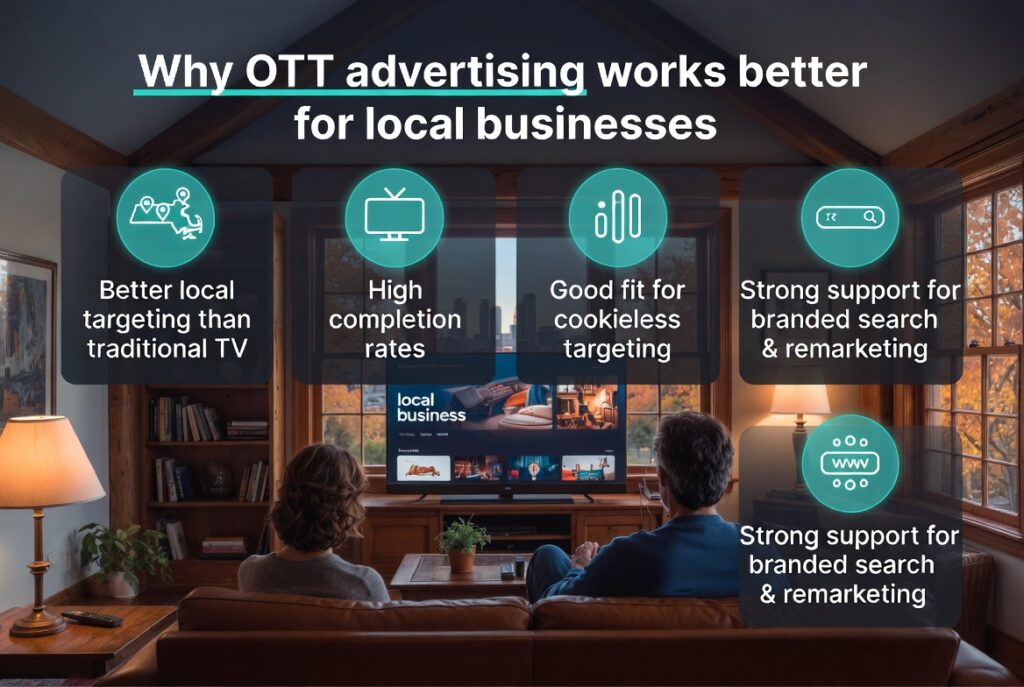
1. Better local targeting than traditional TV
With old-school TV, you often had to buy broad market coverage. That meant wasted spend.
With OTT, you can target much tighter, including:
– Specific zip codes
– Service areas
– Demographics
– Household traits
– Interests and behaviors
For example, a fence company in Dallas does not need to pay to reach viewers 60 miles outside its service radius.
2. High completion rates
Many OTT ads are non-skippable, and completion rates are often much higher than standard online video.
That means people are more likely to actually see your full message.
3. Good fit for cookieless targeting
Third-party cookies are getting less useful. OTT relies more on platform data, contextual targeting, household data, and device-level signals.
That makes it a stronger long-term channel than some old display tactics.
4. Strong support for branded search and remarketing
A good OTT campaign can increase:
– Brand searches on Google
– Direct website visits
– Click-through rates on retargeting ads
– Trust when people compare providers
A homeowner may see your ad on streaming TV today and search your company name next week when they need service.
How OTT advertising is bought
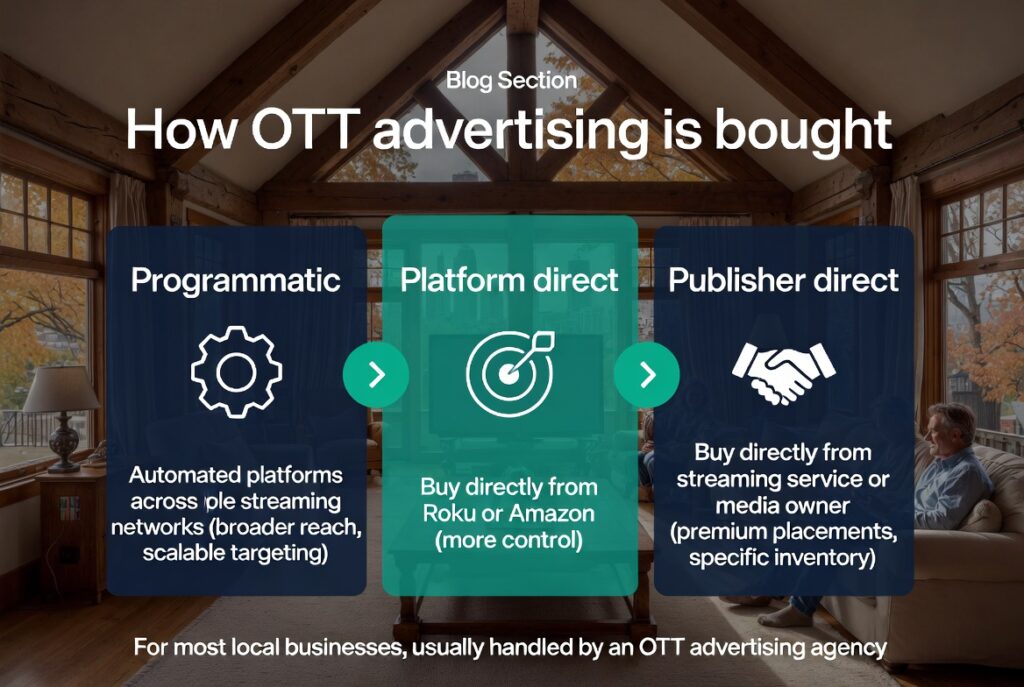
There are three common ways to buy OTT ads:
1. Programmatic
Ads are placed through automated platforms across multiple streaming networks.
Best for: broader reach and scalable targeting.
2. Platform direct
You buy directly from a platform like Roku or Amazon.
Best for: more control over where your ads appear.
3. Publisher direct
You buy directly from the streaming service or media owner.
Best for: premium placements and specific inventory.
For most local businesses, this is usually handled by an agency or media buyer because setup, creative specs, and targeting can get technical fast. In many cases, hiring an experienced OTT advertising agency saves time and helps avoid wasted ad spend.
How OTT advertising is priced
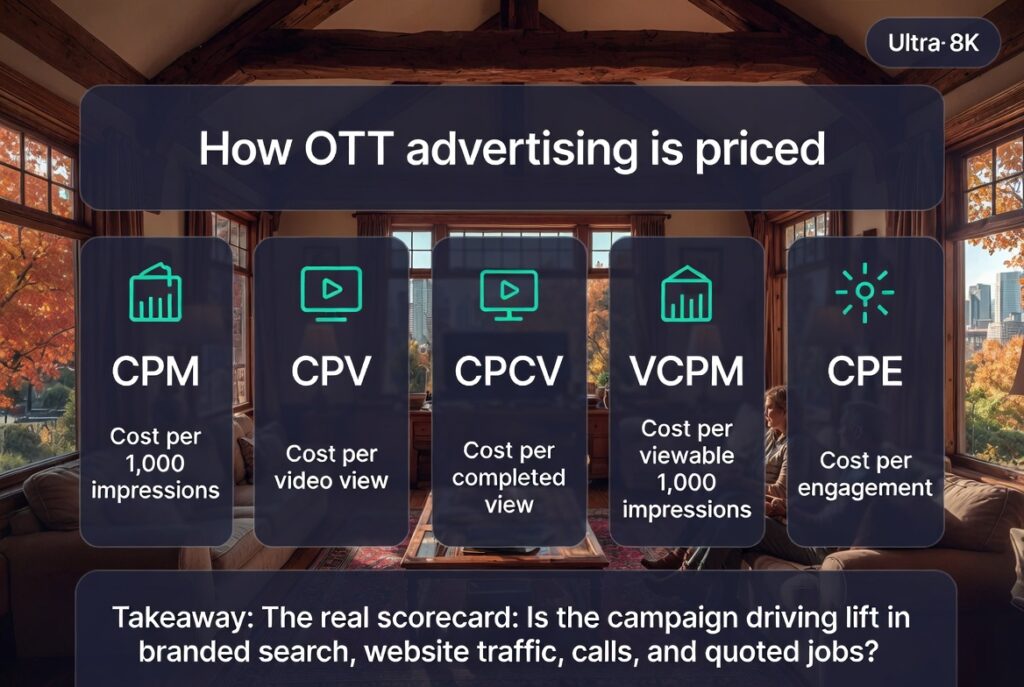
Most OTT campaigns are priced on impressions or video views.
Here are the main terms:
– CPM: cost per 1,000 impressions
– CPV: cost per video view
– CPCV: cost per completed view
– VCPM: cost per viewable 1,000 impressions
– CPE: cost per engagement
For local service businesses, the exact pricing model matters less than this question:
Is the campaign driving lift in branded search, website traffic, calls, and quoted jobs?
That is the real scorecard.
Best practices for OTT ads that actually perform
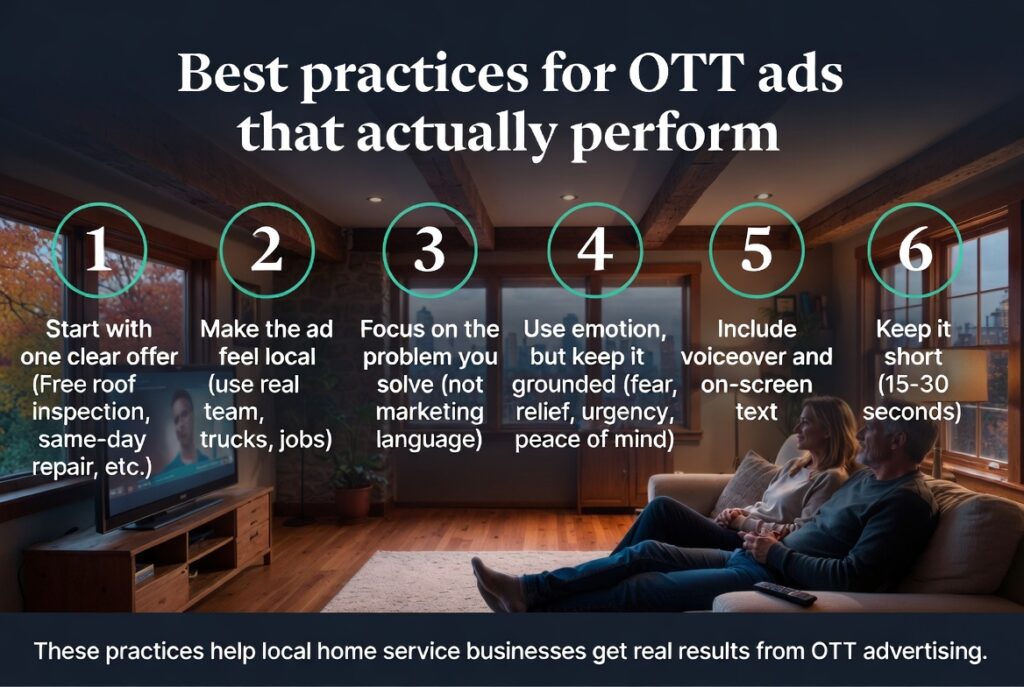
1. Start with one clear offer
Do not try to say everything in one ad. Pick one message.
Examples:
– Free roof inspection
– Same-day garage door repair
– Fast emergency locksmith service
– Free fence estimate
– Financing available for larger projects
2. Make the ad feel local
Generic stock footage usually underperforms. Use your actual team, trucks, jobs, and market whenever possible.
Local trust matters more than polished branding.
3. Focus on the problem you solve
Homeowners care about results, not marketing language.
Instead of saying:
– “We provide high-quality exterior solutions”
Say:
– “Got roof damage after a storm? We inspect it fast and help document it for insurance.”
4. Use emotion, but keep it grounded
Fear, relief, urgency, safety, pride, and peace of mind all work well in home service ads.
Just do not overdo it. Honest and specific beats dramatic and vague.
5. Include voiceover and on-screen text
Some people listen. Some glance at the screen. Some half-watch while doing something else.
Use both:
– Voiceover for your main message
– On-screen text for the key offer and brand name
– Clear CTA at the end
6. Keep it short
For most local campaigns, 15 to 30 seconds is enough.
That is plenty of time to:
– Show the problem
– Present the solution
– Build trust
– Ask for action
A simple OTT ad formula for contractors
If you want a practical framework, use this:
1. Call out the problem
2. Show your team or job footage
3. State your offer
4. Add proof or credibility
5. End with a clear call to action
Example:
– “Garage door stuck?”
– Show your tech arriving and fixing it
– “Same-day service available”
– “Trusted by homeowners across Plano and Frisco”
– “Call now or book your appointment online”
Final takeaway
OTT advertising gives local service businesses something traditional TV never could: the ability to reach the right neighborhoods with a strong video message and better targeting.
It is not the first channel we would recommend for every contractor. Search campaigns still capture high-intent leads faster. But OTT can be a smart move when you want to build awareness, support branded search, and stay visible in a competitive market.
If you decide to test it, keep it simple. One offer. One audience. One clear message. Track what happens after the view—not just the view itself.
And if you want help building a local lead generation system that combines video, search, landing pages, and conversion tracking, Kazakov Agency can help you make every marketing dollar work harder.
📌 Related Resources & Services
Main Service: Explore our comprehensive PPC Campaign Management.
Recommended Articles:
Next Step: Learn how we deliver measurable growth — Social Media & Video Marketing Services.