Local Service Business Lead Generation: Prompt-Based SEO for AI Search
Keyword research is not dead. But it is changing fast, and that shift has major implications for local service business lead generation.
If you run a roofing company, garage door business, fencing company, locksmith shop, or any other local service business, your customers are not just typing short phrases into Google anymore. They are asking full questions in ChatGPT, Gemini, Perplexity, and Google’s AI results.
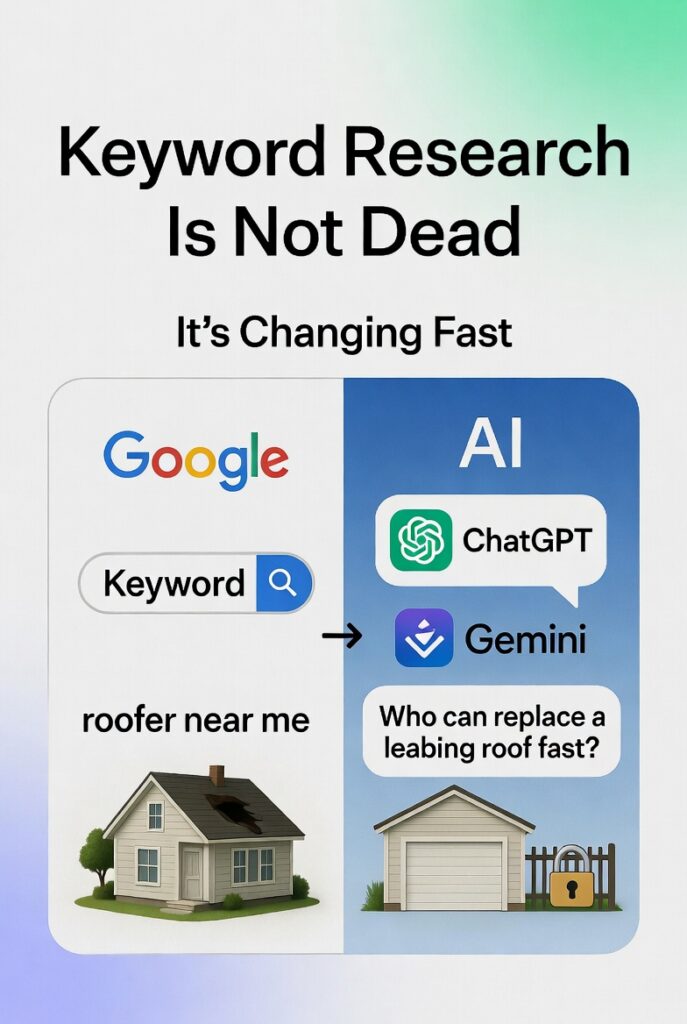
Instead of searching “roofer near me,” they ask: “Who can replace a leaking roof fast and help with insurance paperwork?” Instead of “garage door repair,” they ask: “Who can fix a garage door that won’t close today without charging a crazy service fee?
That shift matters. If your website only targets old-school keywords, you may miss the way real customers now search, compare, and choose.
Here’s how prompt-based SEO works and how to use it to stay visible in the AI era.
Why Traditional Keyword Research Is Losing Ground
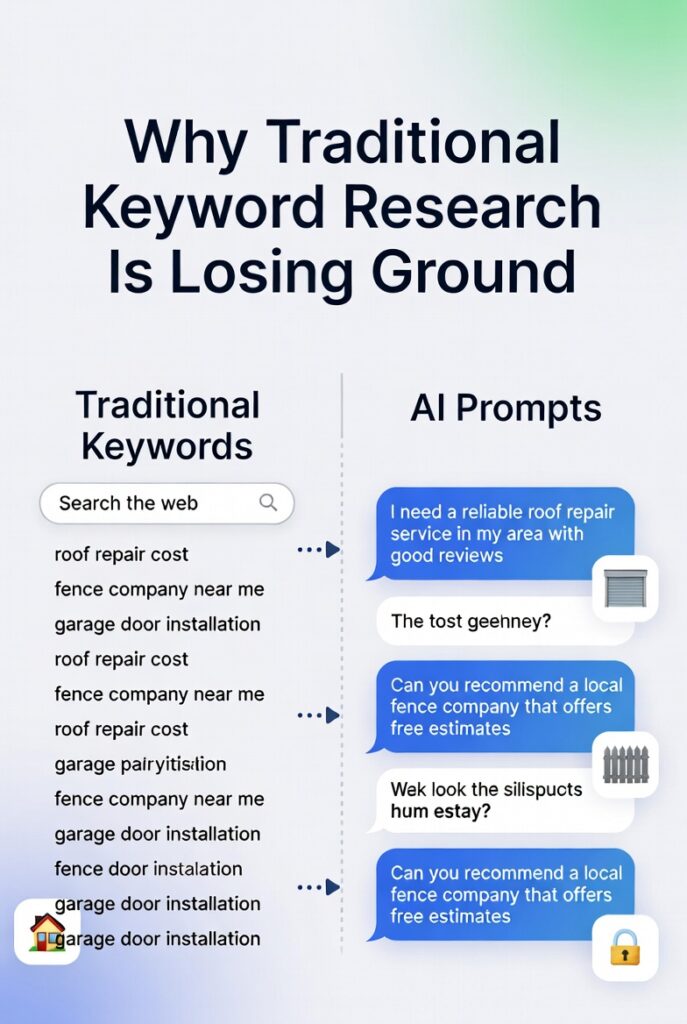
Traditional keyword research still has value. You should still care about terms like roof repair cost, fence company near me, or emergency locksmith. But by itself, it no longer gives the full picture.
Here’s why:
- It looks backward. Most keyword tools rely on historical search data, not live AI conversations.
- It misses intent. Search volume tells you what people typed, not what they actually meant.
- It ignores context. AI tools understand complete situations, not just isolated words.
- It misses follow-up questions. One prompt often leads to several related questions before a customer makes a decision.
In simple terms: keyword tools show the phrase. Prompts show the problem.
And in home services, the problem is what drives the lead.
What Prompt-Based Keyword Research Really Means
A prompt is the natural way a customer asks for help in AI search.
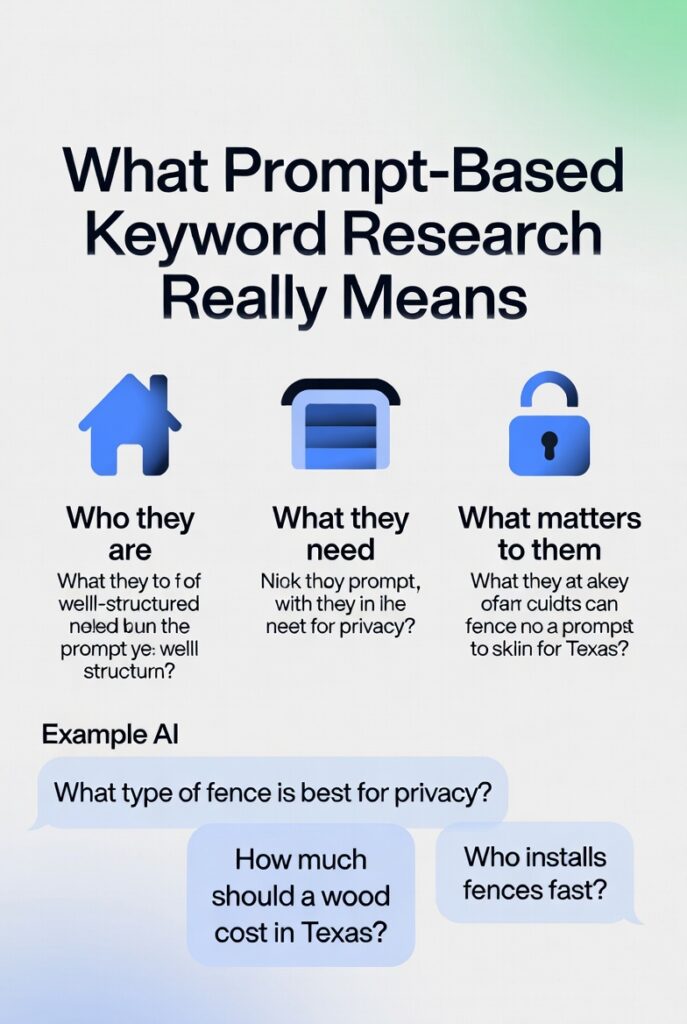
It usually includes three things:
- Who they are: a homeowner, landlord, property manager, or small business owner
- What they need: repair, replacement, quote, inspection, or advice
- What matters to them: speed, price, trust, warranty, insurance help, or availability
For example, instead of targeting only fence installation, you may uncover prompts like:
- “What type of fence is best for privacy and low maintenance?”
- “How much should a wood fence cost for a backyard in Texas?”
- “Who installs fences fast and handles permits?”
Those questions are far more useful than a broad keyword list because they reveal buying intent.
A homeowner asking about permits, pricing, and timelines is much closer to hiring than someone typing a general phrase.
How to Do Prompt-Based Research for Local Service Business Lead Generation
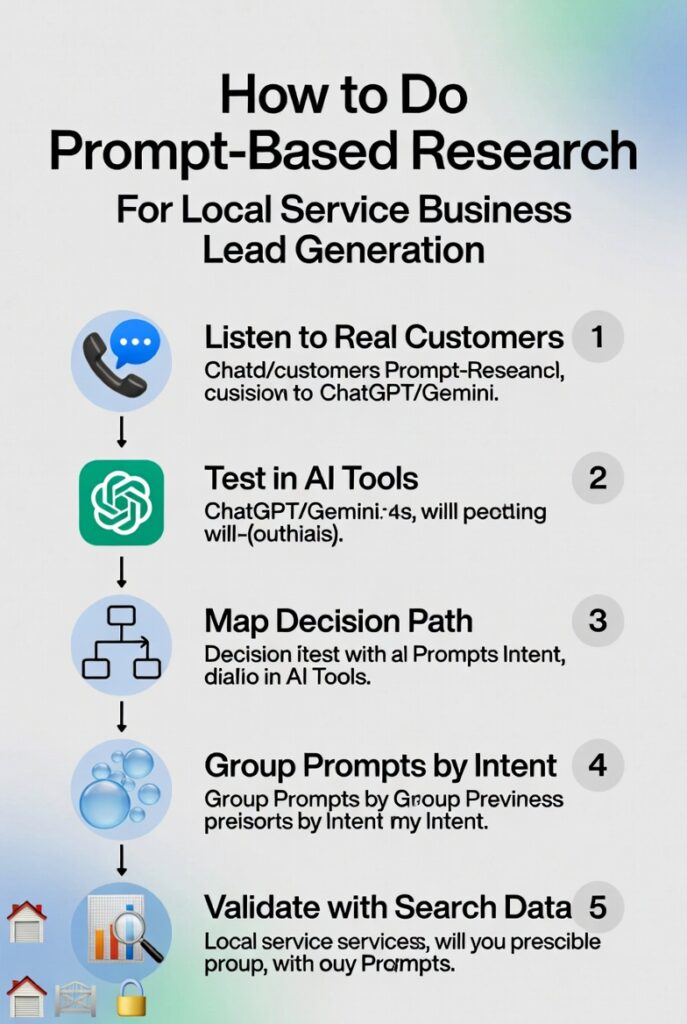
You do not need fancy software to get started. You just need to listen better.
1. Start with your real customer questions
Your best prompt ideas are already in your business.
Look at:
- Phone calls
- Contact form submissions
- Text messages
- Google reviews
- Sales conversations
- Questions your techs hear on-site
If customers keep asking:
- “How long does a roof replacement take?”
- “Can you match my existing fence style?”
- “Do I need to replace the whole garage door or just the opener?”
Those are not just sales questions. They are content topics.
2. Test your topics in AI tools
Go into ChatGPT, Gemini, or Perplexity and type in a basic service topic.
Example: roof leak repair
Then see how the conversation expands. You may find prompts like:
- “Is a roof leak an emergency?”
- “Can I repair part of my roof or do I need full replacement?”
- “Will homeowners insurance cover storm damage?”
Pay attention to repeated patterns like:
- How much does it cost
- How soon can someone come out
- Is it worth repairing or replacing
- What is the best option for my situation
These patterns tell you how customers naturally think.
3. Map the full decision path
Most homeowners do not ask one question and book right away. They move through stages.
A typical prompt flow looks like this:
- Problem: “Why is my garage door making a loud grinding noise?”
- Options: “Can this be repaired or do I need a new opener?”
- Price: “How much does garage door opener replacement cost?”
- Selection: “Who is the best garage door company near me with same-day service?”
If your content only covers the last step, you miss a lot of visibility earlier in the journey.
4. Group prompts by service intent
Once you collect prompts, organize them into clusters.
Example for a roofing contractor:
- Emergency roofing: leak, storm damage, tarp service, insurance questions
- Replacement: cost, timeline, materials, financing
- Trust signals: warranties, licenses, reviews, local experience
- Commercial roofing: flat roof repair, coatings, inspections, maintenance
Each cluster can become a service page, blog post series, FAQ section, or location page.
5. Validate with search data
Prompt research gives you language. SEO tools help confirm opportunity.
Use Google Search Console, Ahrefs, or Semrush to check:
- Which conversational queries already bring impressions
- What related terms appear in Google’s People Also Ask
- Which phrases signal buying intent, like best, cost, same-day, near me, or licensed
For example, a long prompt like “Who can fix my damaged fence after a storm and help with insurance?” may not show much volume exactly as written. But parts of it may map to strong search themes like:
- storm damage fence repair
- fence insurance claim
- fence repair company near me
That is where prompt research and traditional SEO work together.
How to Turn Prompts Into Content That Actually Wins Leads
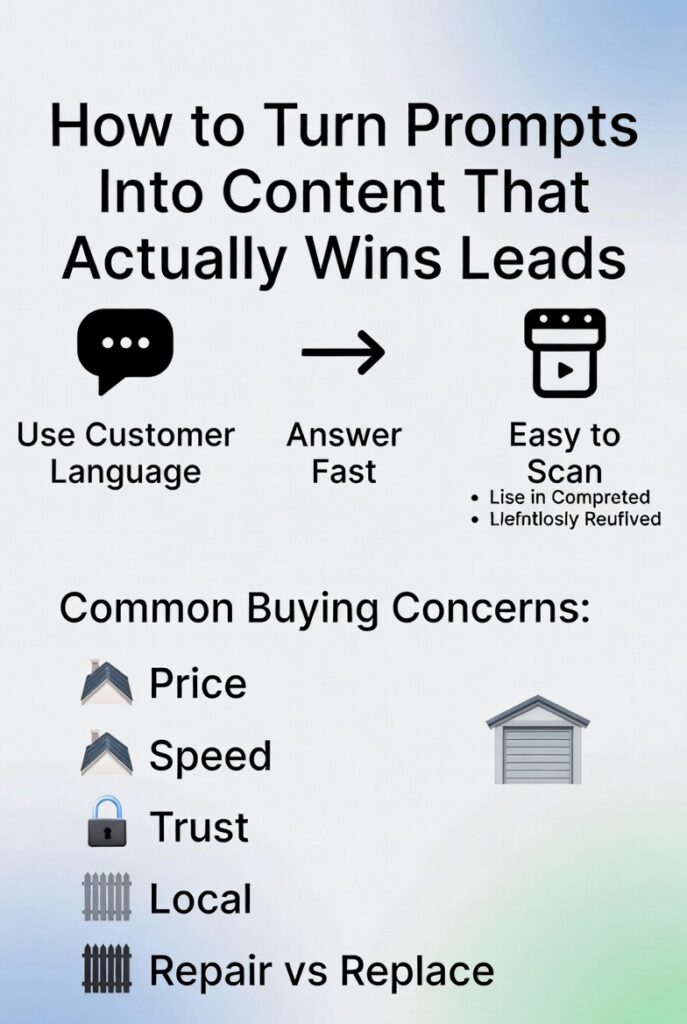
Good prompt-based content does not try to sound smart. It tries to be helpful, clear, and easy for both people and AI systems to understand.
Use the customer’s language
Write the way homeowners talk.
Instead of vague headlines like Residential Exterior Solutions, use direct phrases like:
- How to Tell If Your Roof Needs Repair or Full Replacement
- What a New Privacy Fence Costs in 2025
- Same-Day Garage Door Repair: What to Expect
Clear beats clever.
Answer the question fast
Do not bury the answer under fluff. Start with a straight response, then explain.
Example:
If your garage door won’t close, the issue is often the safety sensors, track alignment, or opener settings. A technician can usually diagnose it in one visit.
That format helps readers and gives AI systems a clean answer to pull from.
Build content around real buying concerns
For local service businesses, the most valuable prompts usually revolve around:
- Price
- Speed
- Trust
- Local availability
- Repair vs. replacement
- Warranty or insurance questions
If your content ignores these issues, it will not convert well.
Structure pages for easy scanning
Use:
- Clear subheadings
- Short paragraphs
- Bullet points
- FAQs
- Simple service explanations
This makes your content easier to read on a phone and easier for AI to understand.
Best Tools for Finding Prompt-Based Keywords
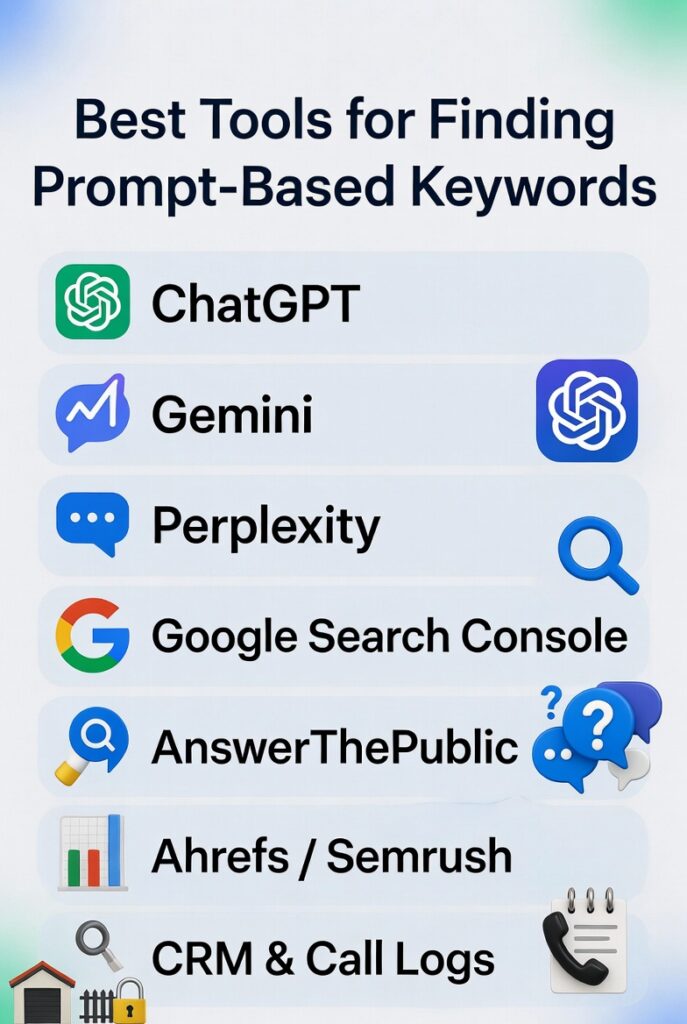
You do not need a huge stack. Start with a few practical tools:
- ChatGPT, Gemini, Perplexity: to explore how questions are phrased
- Google Search Console: to find real queries already triggering impressions
- AnswerThePublic: to uncover question-based variations
- Ahrefs or Semrush: to validate demand and related terms
- Your CRM or call logs: to find real language from actual leads
For contractors, call tracking and sales notes are often more valuable than another keyword export.
How to Measure Success in Prompt-Driven SEO
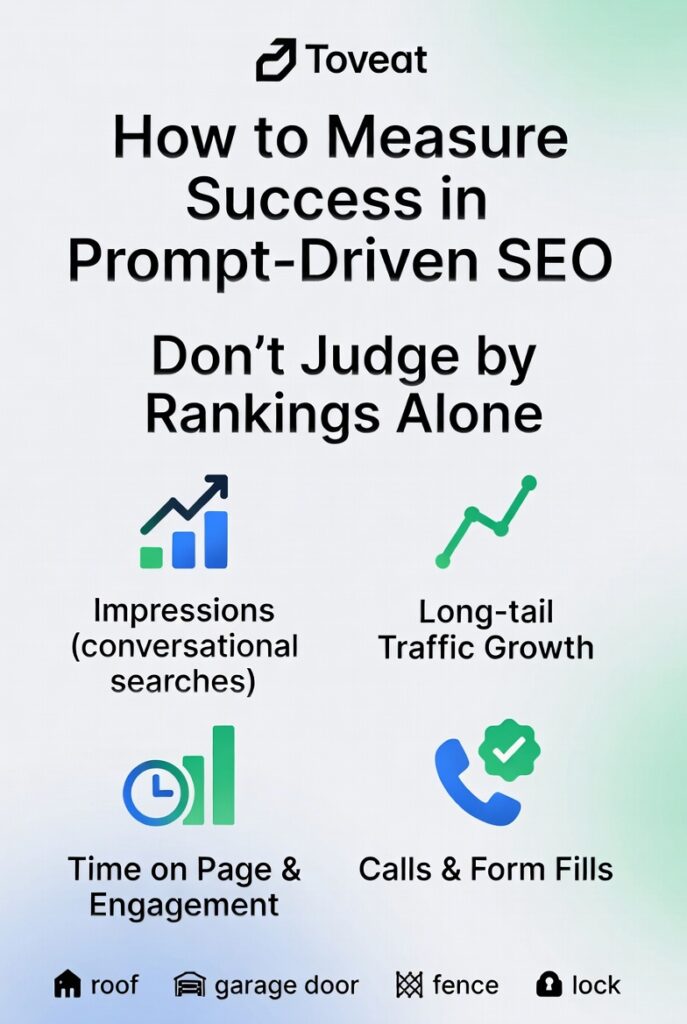
Do not judge this strategy by rankings alone.
Track:
- Impressions for conversational searches
- Growth in long-tail traffic
- Time on page and engagement
- More calls and form fills from informational pages
- Visibility in AI-generated answers
The real goal is simple: show up earlier in the customer journey and build trust before they contact three competitors.
Done well, this approach strengthens local service business lead generation because it helps you attract prospects before they are ready to buy and guides them toward your business with useful answers.
The Bottom Line
SEO is shifting from keywords only to conversations, context, and intent.
For local service businesses, that is actually good news. Homeowners do not want generic content. They want clear answers from a company that understands their problem, their budget, and their timeline.
If your roofing, fencing, garage door, locksmith, or home service business creates content around the real questions customers ask AI, you give yourself a better shot at showing up where buying decisions now happen.
That means fewer wasted clicks, better leads, and content that works harder for your business. It is also a smarter long-term strategy for local service business lead generation in a search landscape shaped by AI.
If you want help building an SEO strategy that fits how local customers actually search today, Kazakov Agency can help you turn those questions into qualified leads.

About the Author & First-Hand Field Methodology
Alexandr (Alex) Kazakov is the Founder & Lead Digital Strategist at Kazakov Agency (Wellesley / Greater Boston, Massachusetts), a Google Ads Partner, and a licensed Massachusetts Home Improvement Contractor (#216197).
Verified Contractor Proof: Every playbook on this site is built from active contractor account audits—including cutting a Los Angeles fence contractor’s Google Ads CPA by 85% ($1,334 to $189 across 589 leads) and generating 605 qualified leads in 92 days for a Florida auto body shop. Explore our verified case studies, transparent retainer pricing, or alexandrkazakov.com.
Last reviewed & updated for Google Search & AI Visibility: November 2026.
📌 Related Resources & Services
Main Service: Explore our comprehensive Professional SEO Services.
Recommended Articles:
Next Step: Learn how we deliver measurable growth — AI Solutions & Marketing Automation.