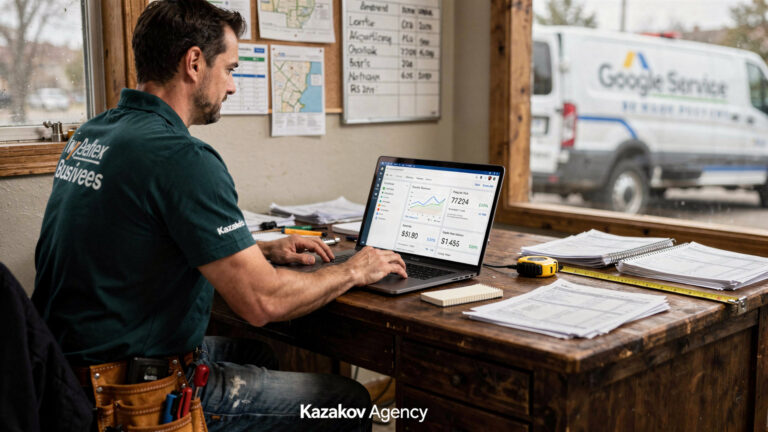
Google Ads Management Services: Win More B2B Leads in 2026
Google Ads can generate profitable B2B opportunities for commercial contractors, local trades, and home service companies—but only when campaigns are built around qualified revenue rather than cheap form submissions. Effective google ads management services connect high-intent searches, persuasive offers, accurate lead tracking, and disciplined budget allocation so owners can see which campaigns produce estimates, contracts, and repeat customers.
Key Questions Answered & Business Benefits
- Core strategy: Capture buyers actively searching for commercial or specialized contractor services.
- Questions answered: Which campaigns, keywords, landing pages, bidding methods, and conversion signals work for B2B lead generation in 2026?
- Direct ROI benefit: Reduce wasted ad spend while generating more qualified calls, estimate requests, and contract opportunities.
Do Google Ads Work for B2B Contractors in 2026?
Yes—when the buyer already recognizes the problem and is searching for a provider. A facilities manager searching for “commercial HVAC repair near me,” a property manager searching for “multifamily roofing contractor,” or a general contractor searching for “licensed commercial electrician” is expressing immediate business intent.
That intent is what separates Google Search from many interruption-based channels. You are not trying to convince an uninterested audience to care about a service. You are positioning your company in front of a decision-maker who may already have a deadline, budget, equipment failure, compliance concern, or project requirement.
Google Ads becomes less effective when a campaign targets broad consumer phrases, sends every visitor to the homepage, or treats every form completion as equally valuable. One purchasing manager requesting a $60,000 project estimate is not equivalent to a job applicant, vendor solicitation, or homeowner outside the service area. Campaign decisions must reflect that difference.
The objective is not to buy more clicks. It is to buy access to profitable demand and convert that demand into measurable sales opportunities.
What Professional Google Ads Management Services Should Include
Reliable management extends far beyond changing bids or adding keywords. For contractors, the system should connect advertising decisions to operational realities such as service capacity, geographic coverage, average contract value, seasonality, emergency availability, and sales follow-up.
1. Offer and Revenue Analysis
Before launching ads, identify the services that justify the acquisition cost. Commercial roof replacement, recurring facility maintenance, industrial electrical work, and multi-location plumbing contracts can support higher lead costs than small one-time repairs. Campaign budgets should prioritize services with sufficient margin, close rate, and customer lifetime value.
Define the acceptable cost per qualified opportunity using real numbers. If a qualified estimate closes at 25%, produces $8,000 in gross profit, and requires no unusual fulfillment expense, the business can make a rational acquisition decision. Without that calculation, a low cost per lead can look successful while producing unprofitable work.
2. Intent-Based Campaign Structure
Separate campaigns by service, buyer type, location, and urgency whenever meaningful. A search for “24-hour commercial plumber” should not share the same message or landing page as “commercial plumbing maintenance contract.” The first buyer needs immediate response; the second needs credibility, scope, and procurement-friendly information.
Useful B2B segments may include commercial services, property management, multifamily properties, industrial facilities, new construction, municipal work, and emergency response. This structure makes budgets, bids, ads, and reporting easier to control.
3. Search-Term Control
Keyword selection is only the starting point. Search-term reviews reveal the actual queries that triggered ads. Negative keywords should filter irrelevant traffic such as training, certification, salary, DIY, supplies, wholesale products, free services, and locations the company does not serve.
Broad match can discover valuable demand when paired with strong conversion data and appropriate bidding, but it should not be treated as permission to stop monitoring relevance. New campaigns with limited data often benefit from tighter targeting until the account establishes reliable qualified-lead signals.
How Google Ads Management Services Improve Conversion Rates
Even excellent targeting cannot rescue a weak destination. B2B visitors need immediate confirmation that the contractor serves organizations like theirs, operates in the required area, and can handle the project scope.
A focused landing page should include:
- A headline matching the service and commercial intent of the search.
- Clear service-area, licensing, insurance, and availability information.
- Relevant proof such as project types, industries served, reviews, certifications, or warranties.
- A short form that asks enough to qualify the opportunity without creating unnecessary friction.
- Tap-to-call functionality and a visible response-time expectation.
- A direct next step, such as scheduling a site visit or requesting an estimate.
Do not force a facilities director to search a consumer-focused homepage for evidence that you perform commercial work. Build a dedicated path for the buyer. When practical, create separate landing pages for high-value services and major markets rather than swapping a city name into otherwise generic copy.
B2B Advertising Requires Better Conversion Signals
Google’s automated bidding systems optimize toward the conversion data they receive. If an account reports spam forms, five-second calls, job inquiries, and qualified estimates as identical conversions, the system may pursue more of the wrong activity.
At minimum, contractors should track:
- Calls from ads and landing pages.
- Qualified form submissions.
- Booked inspections, consultations, or site visits.
- Estimates delivered.
- Closed contracts and associated revenue when available.
Enhanced conversions for leads and offline conversion imports can connect CRM outcomes back to the original campaign, keyword, or ad interaction. This gives bidding systems a stronger signal and gives management a clearer picture of return on ad spend.
Call tracking also matters because commercial buyers frequently call before completing a form. Set a meaningful duration threshold, review recordings where legally permitted, and classify outcomes. A three-minute conversation about an active project should influence optimization differently from a ten-second wrong number.
The Metrics Contractors Should Use to Judge Performance
Click-through rate and cost per click help diagnose campaigns, but they do not determine business success. A high click-through rate can coexist with poor lead quality, while an expensive click can be profitable if it produces a large contract.
Use a revenue-oriented scorecard:
- Qualified lead rate: Percentage of inquiries matching service, geography, budget, and buyer requirements.
- Cost per qualified lead: Ad spend divided by genuine sales opportunities.
- Appointment or estimate rate: Percentage of qualified leads progressing to the next sales stage.
- Close rate: Percentage of opportunities becoming paying customers.
- Customer acquisition cost: Total advertising cost required to win a customer.
- Gross profit return: Gross profit attributed to ads compared with acquisition cost.
Also measure speed to lead. Emergency and high-intent prospects often contact multiple contractors. If calls go unanswered and form submissions wait until the next day, the campaign may be creating demand that a competitor ultimately captures.
A Practical B2B Contractor ROI Scenario
Consider an illustrative commercial HVAC campaign that spends $6,000 in one month and generates 20 inquiries. Twelve are qualified, six receive proposals, and two become customers. The surface-level cost per lead is $300, but the more useful cost per qualified lead is $500 and customer acquisition cost is $3,000.
If those two contracts create $18,000 in combined gross profit, the economics may support additional investment. If they create only $4,000, the team must improve targeting, pricing, close rate, or service mix before scaling. This is why lead counts without sales outcomes are insufficient.
Where B2B Google Ads Campaigns Commonly Waste Money
- Blended consumer and commercial targeting: Residential searches consume budget intended for B2B contracts.
- Oversized geographic targeting: Ads generate leads beyond a practical or profitable service radius.
- Unqualified primary conversions: Page views, button clicks, and low-value actions misdirect automated bidding.
- Generic ad messaging: Ads fail to mention commercial capability, response time, project type, or differentiators.
- Uncontrolled automation: Campaign types are launched without sufficient conversion quality, exclusions, or creative oversight.
- No sales feedback: The advertising team optimizes for forms while the sales team knows those forms rarely become estimates.
Our agency audit process frequently finds that the largest opportunity is not simply lowering cost per click. It is removing irrelevant demand, correcting conversion tracking, and reallocating budget toward services that sales teams can close profitably.
A 90-Day Google Ads Management Services Plan
Days 1–30: Establish Control
Audit existing campaigns, conversion actions, search terms, locations, schedules, devices, landing pages, and call handling. Define qualified-lead criteria with the owner or sales team. Rebuild campaign structure where blended intent prevents useful optimization.
Days 31–60: Improve Signal Quality
Expand negative keyword coverage, test commercial-specific ad messaging, refine landing pages, and connect CRM stages where possible. Review calls and leads weekly to identify patterns. Shift budget from low-value queries toward services and markets producing legitimate opportunities.
Days 61–90: Scale Proven Demand
Increase investment only where lead quality and sales outcomes justify it. Test additional high-intent terms, nearby profitable markets, remarketing audiences, and carefully controlled automated campaign options. Continue testing offers and landing pages rather than assuming bidding changes alone will create growth.
How to Choose a Google Ads Management Partner
Ask potential providers how they distinguish qualified leads from raw conversions, how frequently they review search terms, and whether they can connect campaigns to CRM outcomes. A capable partner should understand margins, close rates, service areas, call handling, and capacity—not just platform metrics.
Request transparency around account ownership, reporting, tracking, fees, and change history. Avoid guarantees of a fixed number of leads without a review of competition, market demand, website quality, budget, and offer strength. No responsible agency controls every auction or buyer decision.
The strongest relationship includes regular feedback from dispatchers, estimators, owners, and sales representatives. Their firsthand knowledge helps identify whether a campaign is attracting decision-makers, price shoppers, homeowners, vendors, or applicants.
Are Google Ads Management Services Worth It in 2026?
For contractors with valuable services, adequate margins, responsive sales processes, and genuine search demand, Google Ads can remain one of the most accountable B2B acquisition channels. The advantage comes from capturing intent at the moment a business buyer is actively evaluating providers.
However, profitability requires more than launching keywords. The winning system combines commercial intent, tightly controlled targeting, dedicated landing pages, qualified conversion tracking, offline sales data, and ongoing budget discipline. When those components work together, google ads management services can turn paid search from an unpredictable expense into a measurable pipeline for estimates, contracts, and long-term customer value.
📌 Related Resources & Services
Main Service: Explore our comprehensive Google Ads Management Services.
Recommended Articles:
Next Step: Learn how we deliver measurable growth — Explore Client Case Studies.