AI Max vs. Broad Match in Google Ads for Local Service Business Lead Generation
Google Ads keeps making search targeting more automated, and that has created a lot of confusion for contractors and local business owners focused on local service business lead generation.
Which Google Ads approach is right for your business?
Answer 5 quick questions and get a personalized recommendation.
One person says broad match wastes money. Another says AI Max is the future. Someone else says you have to use both.
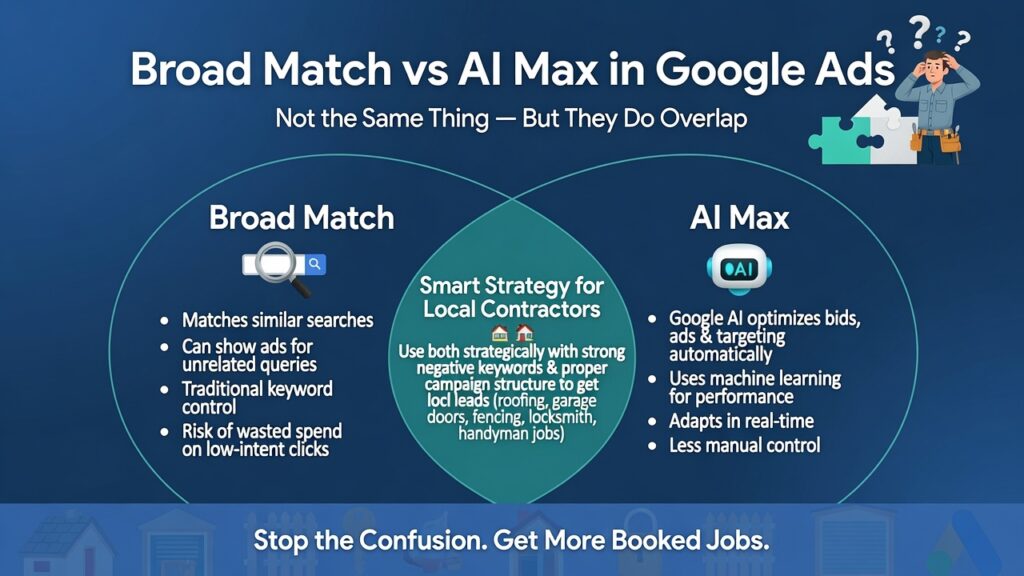
Here’s the simple version: broad match and AI Max are not the same thing, but they do overlap. If you run Google Ads for a roofing company, garage door business, fencing company, locksmith service, handyman business, or another local trade, knowing the difference matters. It affects where your ad shows, what people search, and whether those clicks turn into real jobs.
What broad match and AI Max have in common
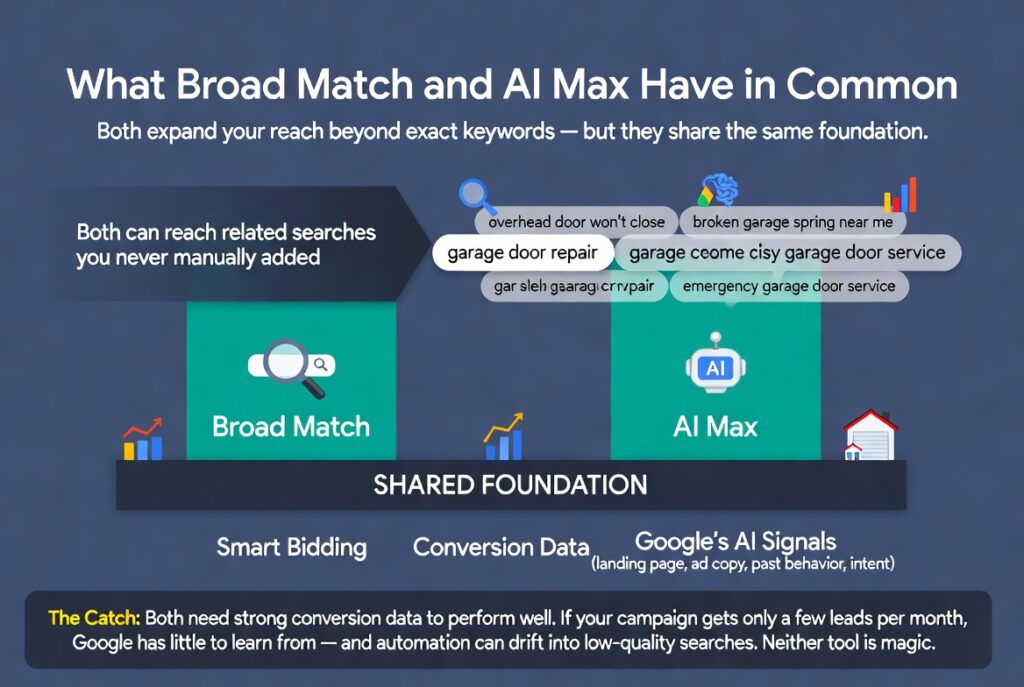
Both tools are built to help Google go beyond tight keyword targeting.
Instead of only showing your ad for exact searches, they let Google find related searches that might convert.
Both also rely on:
- Smart Bidding
- Conversion data
- Google’s AI signals, like your landing page, ad copy, past search behavior, and intent
That means both broad match and AI Max can help you reach searches you never manually added.
For example, if you advertise for garage door repair, Google may also show your ad for searches like:
- overhead door won’t close
- broken garage spring near me
- emergency garage door service
That can be useful. But there’s a catch.
Both need solid conversion data to work well. If your campaign only gets a few leads a month, Google has very little to learn from. In that case, automated targeting often drifts into low-quality searches.
So yes, both can expand reach. But neither is magic.
Why these tools often go wrong
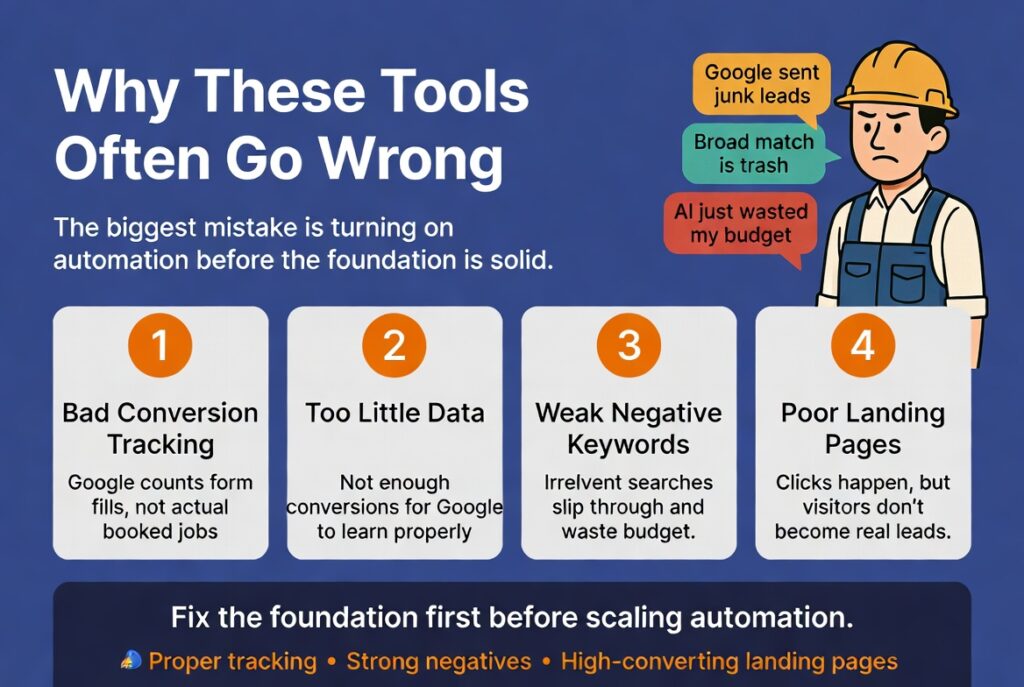
The biggest mistake is turning on automation before the campaign foundation is solid.
If your tracking is weak, your landing page is poor, or your leads aren’t being qualified properly, Google will optimize for the wrong thing.
That’s when business owners start saying things like:
- “Google sent junk leads.”
- “Broad match is trash.”
- “AI just wasted my budget.”
Sometimes they’re right. But the real issue is usually one of these:
- Bad conversion tracking — Google is counting form fills, not actual booked jobs.
- Too little data — not enough conversions for the system to learn.
- Weak negatives — irrelevant searches slip through.
- Poor landing pages — clicks happen, but leads don’t.
For home service companies, this is especially important. A roofing lead is not the same as a window shopper. A handyman call is not the same as someone asking for free advice. Google needs real signals, not just surface-level activity.
What broad match actually is
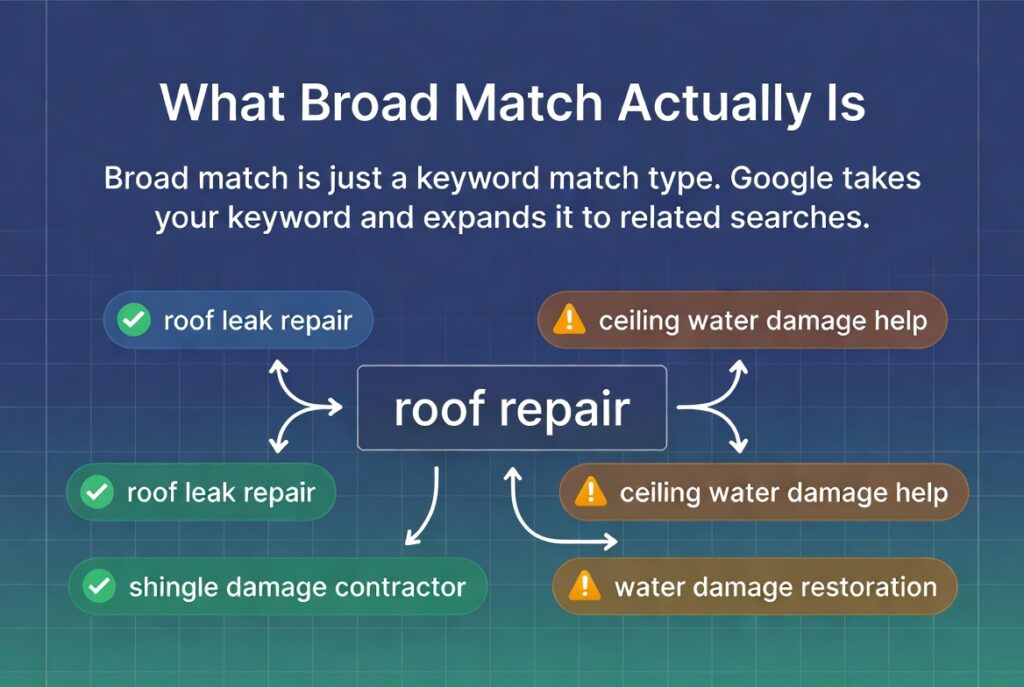
Broad match is just a keyword match type.
You still give Google a keyword, and Google stretches that keyword into related search queries.
Example:
If your keyword is roof repair, broad match may trigger for:
- roof leak repair
- shingle damage contractor
- ceiling water damage help
Some of those searches may be great. Some may be way off.
Broad match gives Google more room than phrase or exact match, but it does not give you the extra controls AI Max does.
What AI Max actually is
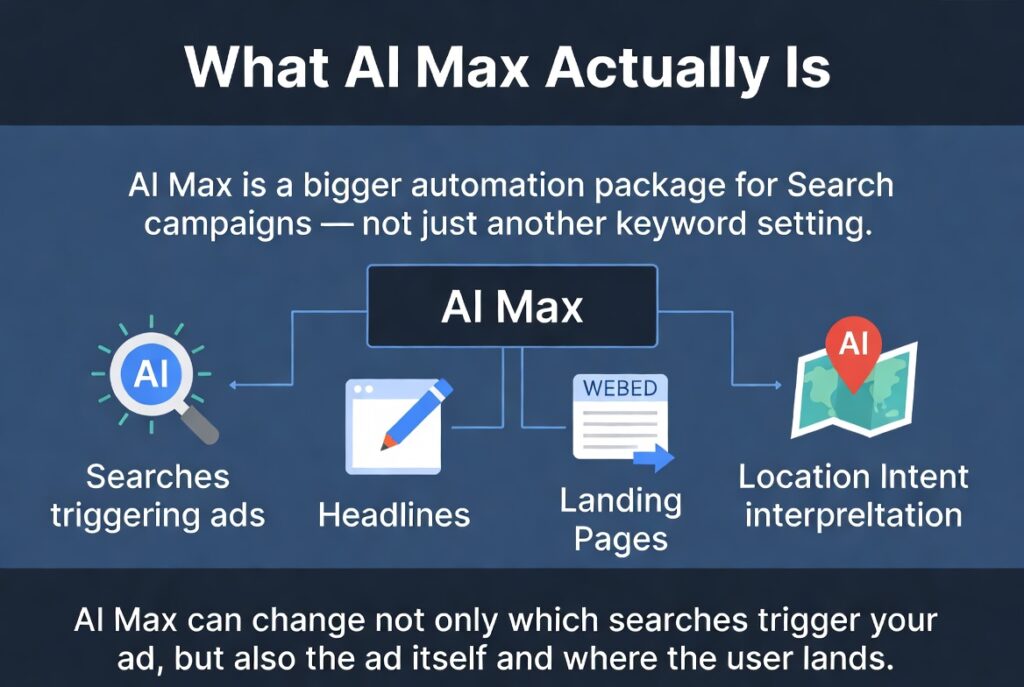
AI Max is a bigger automation package for Search campaigns.
It includes broad, AI-driven query expansion, but it also layers in other features that can change the ad itself and where traffic lands.
That’s the real difference.
AI Max is not just “another keyword setting.” It is a wider system that can affect:
- what searches trigger your ads
- what headlines show
- what landing page the user sees
- how branded vs. non-branded traffic is handled
- how location intent is interpreted
Key AI Max features that broad match does not have
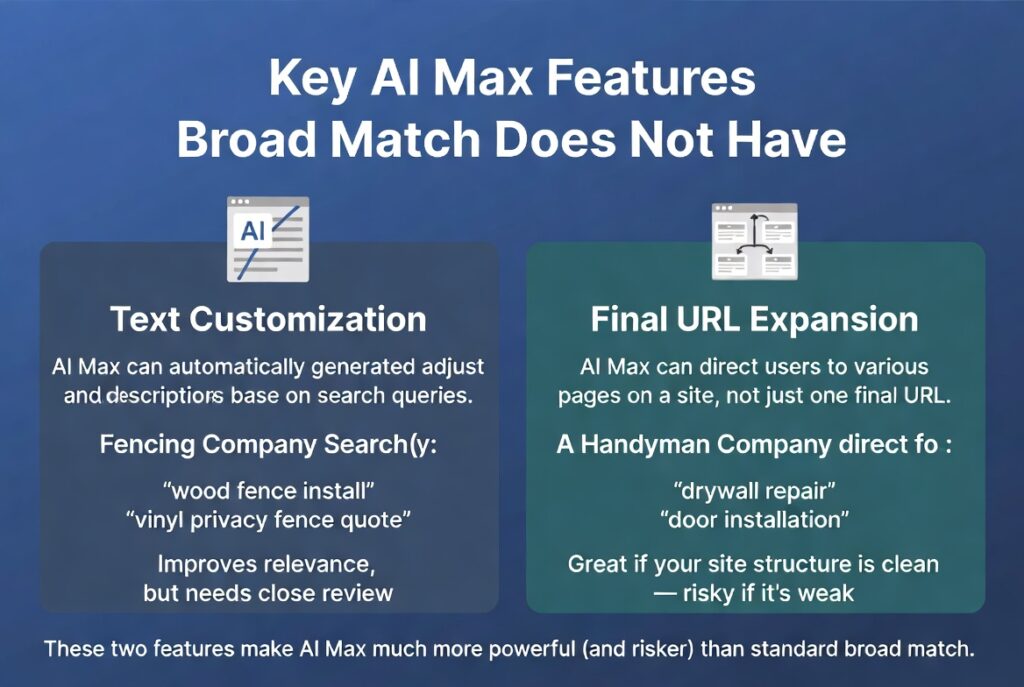
1. Text customization
AI Max can generate and adjust headlines and descriptions based on the search.
That means Google may go beyond the standard Responsive Search Ads you wrote and create variations automatically.
This can help if you offer multiple services and Google needs to better match the message to the query.
Example: A fencing company may have one campaign, but searches vary:
- wood fence install
- vinyl privacy fence quote
- chain link fence repair
AI Max may adapt ad text more aggressively to fit those searches.
That can improve relevance. It can also go off track if your setup is sloppy. So review it closely.
2. Final URL expansion
AI Max can send users to different pages on your website, not just the one final URL you selected.
For local service businesses, this can be powerful if your site is built correctly.
Example:
A handyman company might have separate pages for:
- drywall repair
- door installation
- deck repair
Instead of sending every click to the homepage, AI Max may route the visitor to the most relevant service page.
That usually improves conversion rates.
But if your website is thin, outdated, or confusing, final URL expansion can create a mess fast.
3. Brand settings
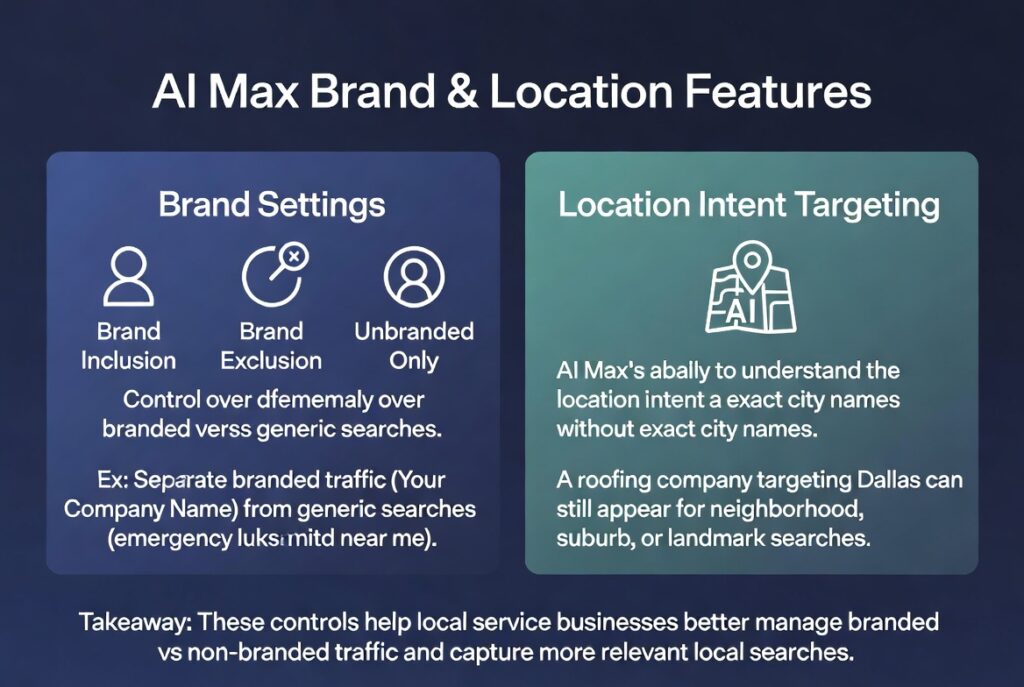
AI Max gives you more control over branded and unbranded search behavior.
You can use settings like:
- Brand inclusion — target searches related to certain brands
- Brand exclusion — avoid searches tied to certain brands
- Unbranded only — block branded searches entirely
This matters if you want to separate people searching your company name from people searching generic services like emergency locksmith near me.
For many local businesses, that split is important because branded traffic usually converts differently and should often be measured separately.
4. Location intent targeting
AI Max can better interpret location-based intent at the ad group level.
That helps when people don’t search the exact city name you targeted.
Example:
A roofing company targeting Dallas may still want to show for searches tied to neighborhood names, suburbs, or local landmarks. AI Max is better at reading that intent than traditional keyword targeting alone.
For local service businesses with clear service areas, this can help expand reach without building endless keyword lists.
5. Better search term visibility
One major advantage of AI Max is improved reporting.
You can get more insight into:
- the search term
- the headline that showed
- the landing page used
That matters because automation without visibility is dangerous. If Google is changing matching, messaging, and landing pages, you need to know what it’s doing.
Which option is better for local service business lead generation?
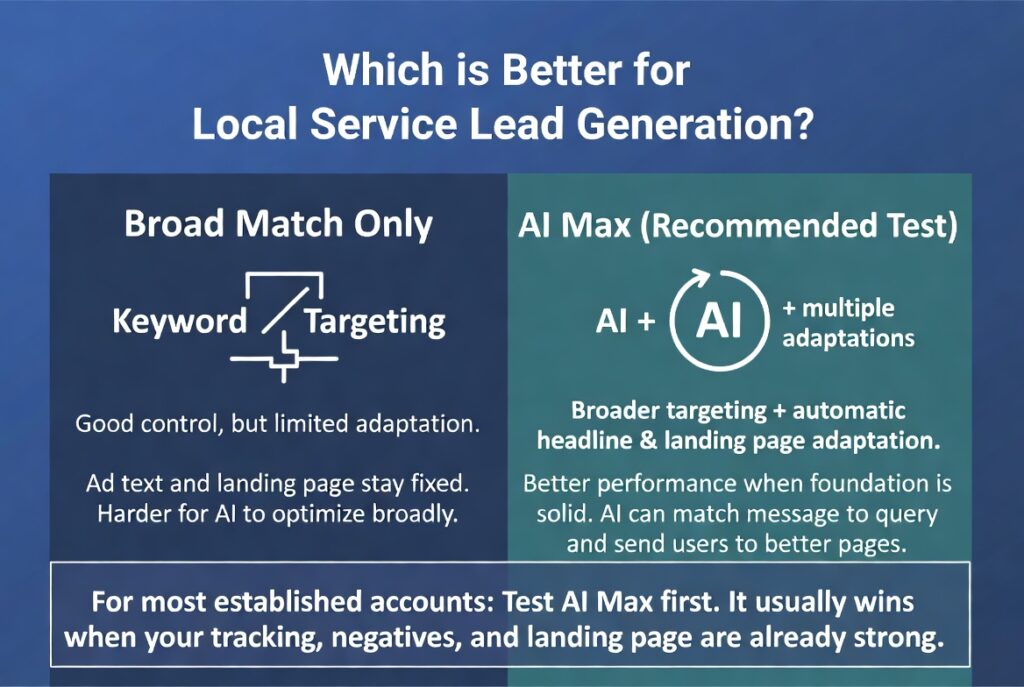
For most established Google Ads accounts, AI Max is the better test.
Why?
Because broader targeting works better when the ad message and landing page can also adapt. That gives AI Max a real advantage over plain broad match.
But that does not mean every business should flip it on today.
When AI Max makes sense
- Your campaign already generates consistent conversions
- Your conversion tracking is accurate
- Your website has strong service pages
- You want to scale beyond phrase or exact match limits
- You can monitor search terms and landing pages closely
Example: If your garage door campaign is already producing qualified calls and booked jobs, AI Max may help you find additional high-intent searches you’re currently missing.
When broad match is the safer first step
- You mainly use exact match today
- You want a controlled test before adding more automation
- Your landing pages are limited
- You’re not ready for AI-generated messaging or URL expansion
In that case, test one broad match keyword inside an existing, healthy campaign. Let it run through at least one to two full conversion cycles, then review lead quality, not just cost per lead.
When you should use neither
- Your campaign barely gets conversions
- Your lead tracking is unreliable
- Your sales team doesn’t mark qualified leads
- Your landing pages are weak
- Your current campaign is already underperforming badly
If your Google Ads account is broken, AI won’t fix it. It will usually just make the problem bigger, faster.
Automation is an amplifier, not a rescue plan.
Best practices before testing AI Max for local service business lead generation
- Fix conversion tracking first. Use real lead tracking, and if possible, import offline conversions like booked estimates or sold jobs.
- Start inside an existing campaign. Don’t launch AI Max on a brand-new campaign if you already have data elsewhere.
- Check landing pages. Make sure each main service has a strong page.
- Review search terms often. Especially in the first few weeks.
- Watch lead quality, not just volume. More leads means nothing if they don’t turn into revenue.
Bottom line
Broad match and AI Max are different.
Broad match is a keyword type.
AI Max is a larger automation system for Search that includes query expansion plus ad text, landing page, brand, and location controls.
If your Google Ads campaign already works and you want to grow, AI Max is usually the stronger option to test. If your account is still fragile, broad match may be the safer step. And if your fundamentals are weak, fix those before adding any automation at all.
Done right, both tools can support stronger local service business lead generation, but only when the campaign foundation is solid.
If you run a local service business and want Google Ads that bring in real jobs, not just clicks, Kazakov Agency can help you build the right foundation first and scale from there.
Get Your Free Strategy Session
📌 Related Resources & Services
Main Service: Explore our comprehensive Google Ads Management Services.
Recommended Articles:
Next Step: Learn how we deliver measurable growth — Locksmith Google Ads Case Study.